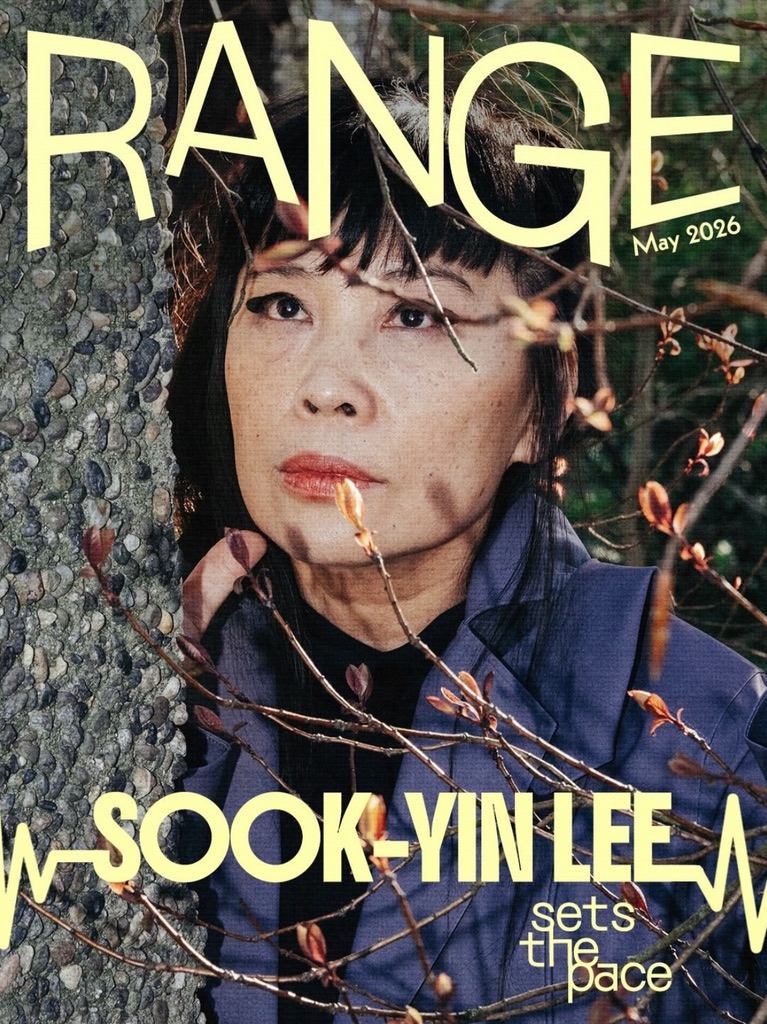
Published as the cover story of RANGE Magazine’s May 2026 issue
Photos by Lia Hansen, art by Sophia Pan
Sook-Yin Lee found her resting heart rate in Barrie, Ontario, at an old Boy Scouts’ camp in the forest, while being bitten by mosquitos. It was summer. Lee hadn’t meditated before. Except maybe subconsciously when she swam—she’d been a competitive swimmer. A friend suggested she try the ancient technique of Vipassana when her heart was badly broken. Lee probably had a nervous breakdown, when she thinks about it. It didn’t help that she was very good at putting her broadcaster face on when she had to, working at CBC at the time. The mask could provide a nice break. You wouldn’t know it though, that underneath she was destroyed.
When Lee arrived at the centre in Barrie for the retreat, she signed a contract to abide by the code of conduct, which included no killing of any living being—including the ravenous mosquitoes—and no talking. No talking was easy. But meditating for hours at a time could be physically painful, manifesting through tight knots in her back. Gradually, the pain would transform, leaving entirely or surfacing elsewhere.
It was, Lee says now, “probably the most incredible healing and mystical experience that I’ve ever had.” And it helped her get through the heartbreak. Two decades later, Vipassana remains a tool available whenever she needs it.
72 beats per minute is considered the normal resting heart rate for adults. The meditative tempo guides Lee’s new album, 72RHR, where every song is built around the beat. It’s blissful and challenging and playful and devastating, with poetic lines and mantras that linger after the song is over, like “ding ding / modern ying ying / mother ding ding / mug up” on “Digital Fire,” Lee’s vocals distorted into a low growl. It’s a mind-blowing experience that transports the listener.
The music moves through many arcs, Lee explains. There’s areas of meditation, but also a lot of upheaval. “A meditation is difficult—it’s as difficult as life. It’s never easy. It’s never sublime. We see these videos where people are on a beach and they’re doing yoga and it looks great in the sun setting. That’s just not my experience of that, of life. I thought that was inspirational for a conceptual idea, to see what I could do within the framework of a particular beat per minute and what is supposed to be your optimal relaxation state.”
Lee is curled up on a chair, speaking on a video call from her Toronto home. Hers is a turn-of-the-century row house, with sage green and burnt orange walls decorated with art and photographs and framed by trailing plants. Light streams from all around. The space radiates tranquility and creativity, and it’s where Lee wrote, arranged, performed, recorded, engineered, and produced 72RHR, with all her instruments and gear within reach. She is expansive, thoughtful, and playful when she speaks—she is a master communicator and multidisciplinary artist, after all: broadcaster, filmmaker, writer, actor, musician, and, for a certain generation of Canadians, one of the coolest VJs at MuchMusic.
“We’re talking about this album and yet how do I even talk about this album?” Lee says, crossing her arms and tucking her hands into the sleeves of her blue hoodie, “because it is such a mysterious process that it’s very hard to describe finitely. And so it’s almost like the best way to talk about the album is just to talk about ideas—or,” she smiles, “about not the album.”
Anyway, it all comes down to art, community, and a pursuit of understanding. Lee tries to live in a way that’s in keeping with the art she makes. “Life is art and art is life,” she says. “It’s important for me to make work that is meaningful to me and fun to make, and that I can work with my friends. The process is key, but I also want to make very good art and art that connects with other people, and I can do that if it connects to me. I mean, I’m acutely aware of my struggles and I’m acutely aware of other people’s struggles. And that is part of the beauty of life. We are on this Earth to learn things. And part of that is how to be a person. And so I think that I’m constantly doing that. Whether or not it’s through my work, I’m doing that every day.”
The earliest years of Sook-Yin Lee’s adolescence were spent in Lynn Valley, a neighbourhood in North Vancouver at the foot of Mount Seymour. She was an expressive kid with a vibrant imagination. Despite her parents, immigrants from Hong Kong and China, both being “very expressive and artful,” Lee wasn’t allowed to take art classes. Art was considered frivolous and she was expected to become a doctor or scientist. Lee describes the home as difficult and violent.
At 15, Lee ran away. She enrolled herself in a new school and signed up for visual art. The teacher was strict and only allowed painting still life with fruit. Lee, filled with intensity, had been painting exploding heads with her fingers. She took her portfolio to the Firehall Arts Centre on Vancouver’s Downtown Eastside, where a work about teen suicide was being staged at the theatre. “I said, ‘I’m a teenager, I understand this stuff, and I’ve got all these paintings. Can I put them up in the lobby during the run of this?’ And they’re like, ‘Yes.’” Lee quickly found community in a group of artists, poets, writers, and musicians, who, she says, “took me under their wings and they became my extended family; the people that took care of me, that I took care of.”
She moved into a house in Strathcona, “a prolific space for artists,” on tree-lined Hawks Avenue. “We were all starving back then and we all helped one another. I would hang out at this place called the Ranch and it was proliferated by all kinds of artists of different disciplines. And they would say, you know, ‘Just grab whatever and contribute to just making music. Let’s make something now.’ And it wasn’t like, grab a guitar and play your song. It was like, I’m grabbing a steel pipe and I’m hitting it and making weird sounds. And they were like, ‘Great!’”
“That environment that really nurtured my voice,” Lee continues. It made for an upbringing she lovingly describes as “acoustic,” with a found family that “really lifted me up,” including her first band, Bob’s Your Uncle. It cemented how important it is to be honest and express what you need to—and, she notes, “not curbing it to be palatable for others.” It also instilled the importance of community, which Lee carries with her today.
Her singular voice landed her at MuchMusic in Toronto in 1995. “I really approached MuchMusic with the vision of a performance artist to see what I could get away with on live mainstream television,” Lee says. She hosted The Wedge, the station’s alternative rock show. “I was interested in music, as well. That was the year punk broke, so interesting music was coming into the mainstream. I thought I could contribute to that, to that discourse.”
Part of that time in Lee’s life is depicted in Paying For It, her 2024 sex work comedy, an adaptation of cartoonist Chester Brown’s graphic novel. It’s enjoying a run across North America, and Lee was recently in New York for its American theatrical debut. She co-wrote and directed the film, and composed and performed its soundtrack with frequent collaborator Dylan Gamble. Featuring jazz, grunge, and rave techno, it captures the varied sound of the 90s while scoring the film’s heartfelt look at love and self-discovery. Gamble plays synthesizer on 72RHR.
When Lee first started making music, she’d try to write songs on her guitar. But it always felt forced. While making their last album, 2021’s jooj two, Lee and her late partner Adam Litovitz created a process where they passed sounds back and forth, responding and reworking them in the moment—stretching, turning, looping until they were both happy with the result. Lee describes it as sculpting. She does this her own way on 72RHR, where she manipulates analog technologies, like an old mobile phone, and recorded sounds, like the storeowner in her neighbourhood who likes to yell. These are looped along with machines, synthesizers, organs, guitars, woodwinds, percussion, and noisemakers.
“To add little scraps and digital ephemera that are part of the chaos of the world and then put it within this context,” Lee explains, “is a way of embracing all of those elements and letting them be, but also incorporating them and transforming them.” “Mending Wall,” for example, churns darkly around its beat; with the processing of Lee’s vocals and a buzzing, industrial musical break, it sounds like a busy mind.
Litovitz’s presence is lovingly felt throughout 72RHR. On “Green Tara,” Lee chants “ohm tarre tutarre turre soha,” a “heart-opening” mantra of the Buddhist goddess representing compassion and overcoming obstacles. Lee and Litovitz practised the mantra together and it also appears on jooj two on its closing track, “Adam.” Lee continues to keep his spirit alive. “He’s right there!” she exclaims, pointing to her left. “He’s staring at me right now. He’s on his chair meditating. I have a wall full of photos of us. He had this favourite chair. We’d go swimming at the public pool around the corner, and I’d swim longer ’cause I’m a fish, and he would get out earlier and find the hallway where there was a big duct that had a lot of white noise. He had this blue folding chair that he would love to sit in and just do a meditation while waiting for me to come out.”
Lee released jooj two posthumously. Mixer Steve Chahley helped see it through. “While making jooj two, Steve’s mother passed and then Adam passed,” Lee says, “but we worked with our losses, determined to finish the album that was dedicated to Adam. Steve and I have a mutual bond that is hard to put to words.” She reached out to Chahley to mix 72RHR.
When it comes to lyrics, Lee’s writing process mirrors the alchemic exercise of the sound. She’ll transcribe a sound, one word might lead to another, or words might just sound interesting together. Some songs on 72RHR, like “Unlock the Pain,” have just an abstract line or two: “Take a look at / Unlock the pain.” But others, like “Travelogue Without Moving” and “I Want to Tell You,” are more literal—a vignette of that winter Lee broke her leg: “I wear a grey tracksuit / I need a headband / I need a sweat stain”—and a heartbreaking declaration of love: “I want to tell you / Look how fine you are / I want to know what’s near you / And I know it’s raining / I want to tell you so much I love you.”
In this way, the songs are like poems, Lee says. “I save storytelling for movie scripts that really require a particular syntax, dialogue. For music, I’m looking for finding form and pattern and ideas and feeling, through these other ways of piecing together a song. I loved the freedom of working in that way.”
And poetry, she notes, pulling her dark hair up into a top knot, can highlight something specific in its abstraction.
Sook-Yin Lee was hanging out with filmmaker David Cronenberg and cartoonist Art Spiegelman recently. “Art, David,” she said. “It’s kind of like ’68, isn’t it?”
“Worse,” they responded.
1968 was marked by global political, social, and cultural unrest. “There was a lot of great art being made because it was a reflection of artists engaging with that present moment,” says Lee. And now here we are—war and unrest on every front, the world on fire again. “Art is very important right now. These voices are very important and we’re seeing them pulled back. But the spirit is strong and the tenacious art expression is alive and well. People are making it and then people will have to find it.”
Lee set out to make a contribution in response to it all: the pandemic, losing Litovitz, the state of the world, everything. “But something that had utility to it,” she says, “and wasn’t an empty promise of everything feeling good and peaceful. I wanted to offer something that was one experience of responding to the world as it is.
“I wanted to make a contribution because art saved my life.”